
Information Session on the NATIONAL ENERGY TRANSITION FRAMEWORK
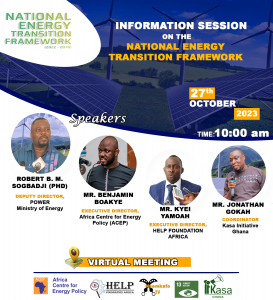
Information Session on the NATIONAL ENERGY TRANSITION FRAMEWORK
STAY TUNED AS WE UPDATE THE ZOOM LINK HERE COME BACK LATER PLEASE
REGISTER FOR THE WEBINAR LINK

ZOOM LINK
Background
Climate change is a real and undeniable threat to our entire civilization, global warming is bringing harm to human communities and the natural world. The United Nations’ Sustainable Development Goal 13 and the 2015 Paris Agreement on Climate Change were adopted to combat climate change and its effects. Despite modest efforts made since the Paris Agreement, global emission levels are still rising and fall far short of the Agreement’s ambitions.
The effects of climate change are already visible and will be catastrophic unless we act decisively. The average global temperature has seen a gradual increase since the industrial revolution. This rise is due to anthropogenic greenhouse gas (GHG) emissions. This necessitates the acceleration of efforts to achieve net zero GHG emissions because further temperature rises will have a devastating impact and therefore more Climate Action and Energy Transition is urgently required.
Countries including Ghana must commit to transition to net-zero GHG emissions for the following reasons: potential threat to energy security; reduced funding for fossil-related projects; potential stranded assets; job losses; potential royalties and revenue loss in the oil and gas sector; and access to the global green market.
Ghana recognizes that the energy and transportation sectors are key areas in reducing emissions toward a net-zero emissions future. To attain this, Ghana plans to transition to the production and utilization of clean energy and the implementation of measures to mitigate any emissions that occur in the process. Ghana plans to contribute her quota to the reduction of global GHG emissions, and, more importantly, achieve decarbonization, energy access and security, and energy efficiency.
As a result, Ghana Government has developed a National Energy Transition Framework, which is aimed at decarbonizing the energy sector. This is a long-term net-zero framework (2022-2070), expected to complement existing efforts with new measures, such as increased renewable energy penetration, conversion of thermal plants to natural gas and the integration of nuclear power into the energy mix. It is expected that the National Energy Transition Framework will serve as a blueprint for transitioning Ghana into a climate-resilient low-carbon energy country, that will accelerate her development efforts, and enhance the well-being of her people without sacrificing the quality of her environment and resources. Ghana plans to establish the National Energy Transition Implementation Committee, and set up the National Energy Transition Coordinating Office to drive the implementation of this framework, with participation by key institutions.
To build collective support, ownership and commitment, there is the need for civil society organizations and other stakeholders including the media, academia, businesses, traditional leaders, communities, etc. to be engaged to understand the content and the aspirations of the National Energy Transition Framework and expected roles of stakeholders.
In view of this, in June 2023, Kasa Initiative in Ghana organized a forum for selected CSOs on Ghana’s National Energy Transition Framework in collaboration with Ghana Ministry of Energy. The forum in June provided background information on the Framework to few CSOs but has driven the interest of many other stakeholders, who want to gain knowledge about the framework and learn how they can contribute to the implementation.
As a follow-up to the June meeting, HELP Foundation Africa under the Extractive Industry and Climate Change Governance Fund, managed by ACEP is organizing this virtual forum in collaboration with the Kasa Initiative in Ghana and the Ghana Ministry of Energy and other partners as part of series of information sessions and dialogue on the National Energy Transition Framework.
Aim of the Virtual Forum
The Aim of the Virtual Forum is to promote shared vision and ownership of the policies and measures in the Framework to facilitate collective implementation.
Objective of Virtual Forum
The objectives of the Virtual Forum are to among others;
- Support the process by providing platform for stakeholder consultations and meetings to solicit their inputs for operationalization of the Framework.
- Identify stakeholder roles and ensure public ownership of the policies and measures in the Framework.
- Harness stakeholder participation for the implementation of the Framework.
Outline of Webinar
Date: Friday 27th October 2023
Time: 10:00a.m.
Venue: Virtual
Duration: 120mins
| Duration | Activity | |
| Moderator’s Opening remarks | HELP Foundation Africa | |
| 5mins | Purpose of Webinar | |
| 5mins | Introduction of Stakeholders | |
| Brief on June 2023 forum for selected CSOs on Ghana’s National Energy Transition Framework. | Kasa Initiative in Ghana, | |
| 45mins | Presentation:National Energy Transition Framework | Ministry of Energy: Deputy Director, Nuclear & Alternative Energy |
| 15mins | Comment by Partners (5mins Each) | ACEP CSOs SDG 13 sub-platform etc |
| 40mins | Open Forum (Questions, Comments, Answers) | All Participants |
| 5mins | Recap of Key Points, Conclusion and Next steps | HELP Foundation Africa |
| 120mins |